
We'd been catching up on city pleasures at Volos; like visiting doctors, buying boat presents and shopping until we're dropping, but it came time to leave. We need to make some miles southwards, we'd planned to pick up some more boat goodies at Lavrio, outside Athens, so the Evvia (or Euboea) channel was calling.
Evvia is a long island that wraps itself along the Greek Aegean coastline, leaving a small channel that is navigable. The channel narrows dramatically at Khalkis, where a draw-bridge only 30m wide spans between the mainland and the island. Our first port of call was Oreoi.
I love the simple sun-drenched shapes in the Mediterranean. The simple primary colours and the way the sky blends into the sea, against a backdrop of steel blue mountains.
We've been witness a wondrous sea-scape going down the channel. Either side is flanked by majestic mountains, cliffs that plunge into the sea.
Our next port was the ridiculously narrow port of Limni. This port is a long narrow sea wall, with a narrow entrance where you barely miss the beach.
When we came to leave Limni, there was no way we could turn the boat around, so we had to hand-walk the boat past the large ketch that docked behind us, and then reverse the boat out the narrow entrance. That kept the neurones engaged!
It was amusing to watch a 100 foot luxury super-yacht try to get into the port. They hastily realised that they wouldn't fit, and reversed the hell out of there before they became wedged into the port.
We met a lovely young Austrian couple who had sailed a tiny 5.2 m boat down from Vienna, through the Danube and the Black Sea to the Mediterranean. It was washing day, and they needed every spare inch of space to hang out their clothes. Its great seeing the spirit of adventure still alive in the young.
In Volos, we discovered the wonders of dining at Tsipouradiki. These are traditional ouzeri's that serve tsipouro (a fiery spirit distilled from grapes, similar to ouzo but not flavoured with anise) along with mezes, small seafood dishes. A 'round' is a small bottle of tsipouro and a seafood dish. You keep eating and drinking as long as you want, but Megan and I found that one round was enough to fill us and keep us light on our feet! Each round is about 4 Euro, so it makes for a cheap meal. We had a great seafood platter at this tsipouradiki in Limni.
After a peaceful night at anchor, we headed south down the South Evvia channel, but thats another story!
 |
| Map of Evvia |
Evvia is a long island that wraps itself along the Greek Aegean coastline, leaving a small channel that is navigable. The channel narrows dramatically at Khalkis, where a draw-bridge only 30m wide spans between the mainland and the island. Our first port of call was Oreoi.
 |
| Pavlov at Oreoi dock |
 |
| Oreoi port, primarily a fishing port |
 |
| Megan, the original dock cowboy. |
We read an interesting story of how the village fishermen discovered a marble bull antiquity in the harbour. They managed to retrieve the bull, and it is now displayed in the village square.
 |
| Marble bull |
I love the simple sun-drenched shapes in the Mediterranean. The simple primary colours and the way the sky blends into the sea, against a backdrop of steel blue mountains.
 |
| The colours of the Aegean. |
 |
| Its a simple life |
 |
| The road out of town. |
We've been witness a wondrous sea-scape going down the channel. Either side is flanked by majestic mountains, cliffs that plunge into the sea.
 |
| Evvia sunrise |
 |
| Majestic cliffs |
 |
| Approaching Limni |
 |
| Mountains and sky |
Our next port was the ridiculously narrow port of Limni. This port is a long narrow sea wall, with a narrow entrance where you barely miss the beach.
 |
| Narrow entrance to the port |
 |
| Pavlov docked in Limni |
When we came to leave Limni, there was no way we could turn the boat around, so we had to hand-walk the boat past the large ketch that docked behind us, and then reverse the boat out the narrow entrance. That kept the neurones engaged!
 |
| Pavlov at the far end of the dock |
It was amusing to watch a 100 foot luxury super-yacht try to get into the port. They hastily realised that they wouldn't fit, and reversed the hell out of there before they became wedged into the port.
 |
| No room in the inn for this fellow |
We met a lovely young Austrian couple who had sailed a tiny 5.2 m boat down from Vienna, through the Danube and the Black Sea to the Mediterranean. It was washing day, and they needed every spare inch of space to hang out their clothes. Its great seeing the spirit of adventure still alive in the young.
 |
| Washing day |
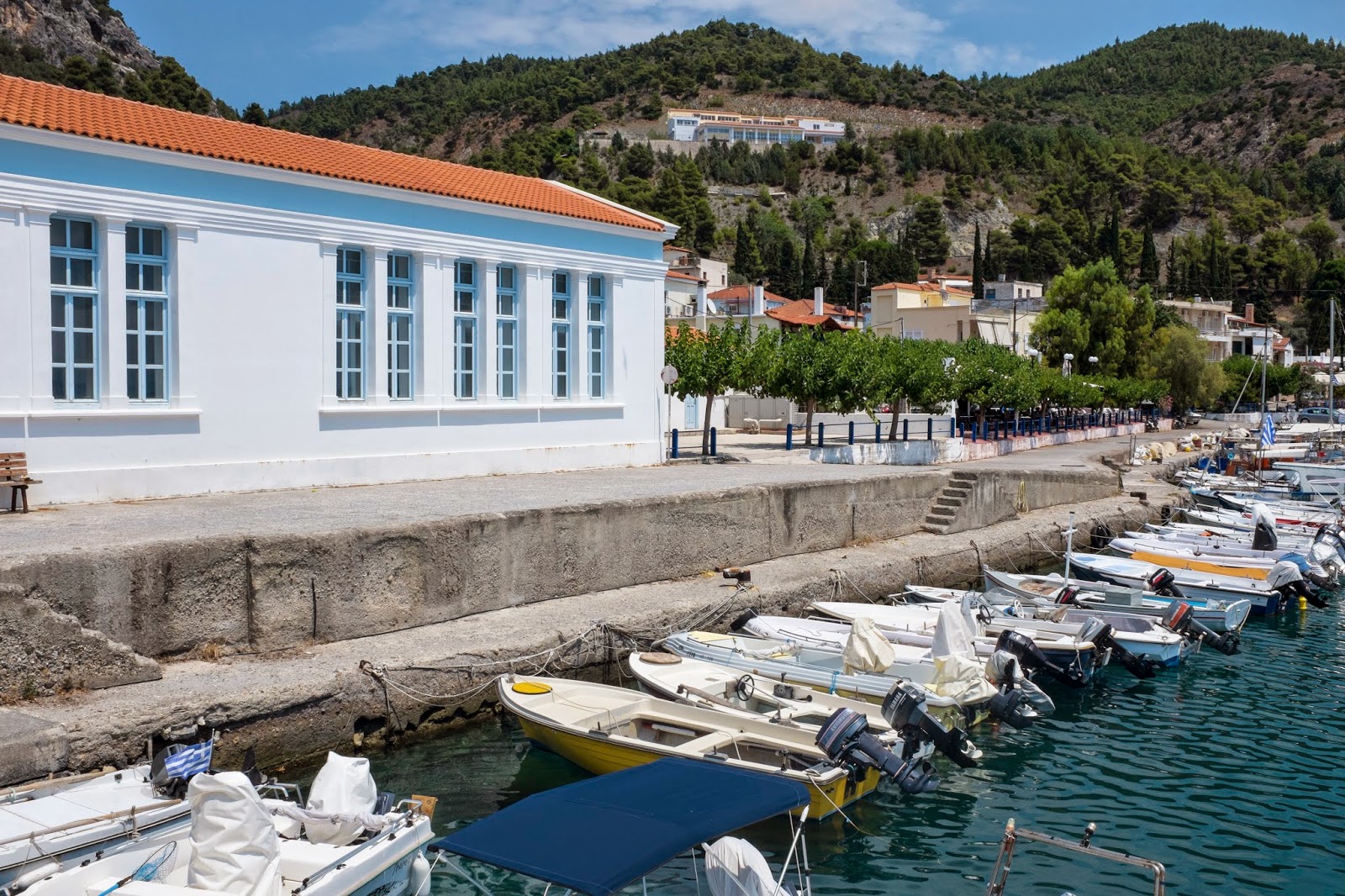 |
| Classic village architecture |
In Volos, we discovered the wonders of dining at Tsipouradiki. These are traditional ouzeri's that serve tsipouro (a fiery spirit distilled from grapes, similar to ouzo but not flavoured with anise) along with mezes, small seafood dishes. A 'round' is a small bottle of tsipouro and a seafood dish. You keep eating and drinking as long as you want, but Megan and I found that one round was enough to fill us and keep us light on our feet! Each round is about 4 Euro, so it makes for a cheap meal. We had a great seafood platter at this tsipouradiki in Limni.
 |
| Megan at the Tsipouradiki |
 |
| Stone architecture |
 |
| Trawler at the end of the dock |
 |
| Swimming beach at the end of the dock, what could be better. |
We left Limni the next day to head down to the intriguing drawbridge at Khaldiki. There were some pretty impressive mountains, around 2500m high on the island of Evvia, as we went down the channel. These peaks can also generate some pretty fierce gusts, or 'bullets' to use the Australian vernacular.
 |
| Mountains plunging into the sea |
 |
| These cliffs are over 2000m high |
 |
| Coast scape along the Evvia channel |
At the bottom of the North Evvia channel is the town of Khaldiki, previously called Negroponte (or Black Bridge) in ancient times.
 |
| The opening into the Khaldiki drawbridge |
 |
| Entering the small port |
 |
| You can just see the drawbridge at the end |
 |
| Pavlov at the Khaldiki dock, waiting to pass through the bridge. |
The tides are very complex at Khaldiki, as this tiny channel, barely 30m wide, connects the North and South Evvia waterways. The tidal currents change direction several times daily, and they cannot predict when slack water will be. This phenomena was said to have driven Aristotle mad! We went to the port police and paid our fee to pass the bridge in the afternoon. We were instructed to monitor Ch 12 on the VHF after 2200. When they detect slack water, the drawbridge is pulled back and we would be called on the radio and instructed to pass the bridge. Our warning notice came around 2330, we slipped our lines and drifted out into the dark night, along with 5 other vessels. When our call came on the radio, we throttled up and passed through the bridge. On the other side is a large shallow bay (South Harbour) where we anchored for the night.
 |
| Town dock at Khaldiki |
 |
| Civic town hall |
 |
| The port looking north, Pavlov in the distance |
 |
| A view of the drawbridge. It slides open from the centre. |
 |
| Southside of the drawbridge |
 |
| Another Nike sculpture |
 |
| Battlements of the bridge |
After a peaceful night at anchor, we headed south down the South Evvia channel, but thats another story!


